


Exploring Āta: Guiding Principles for Our Work at HOST

In Aotearoa New Zealand, social service work is increasingly shaped by Māori knowledge systems that emphasise relational integrity, care, and respect. One of the most influential frameworks in this space is Āta, articulated by Pohatu (2013) as a set of principles that guide people to act with deliberation, dignity, and ethical responsibility. Āta is about deepening the quality of our relationships. For us at HOST International Aotearoa, the principles of Āta offer a powerful guide for practice.
What is Āta?
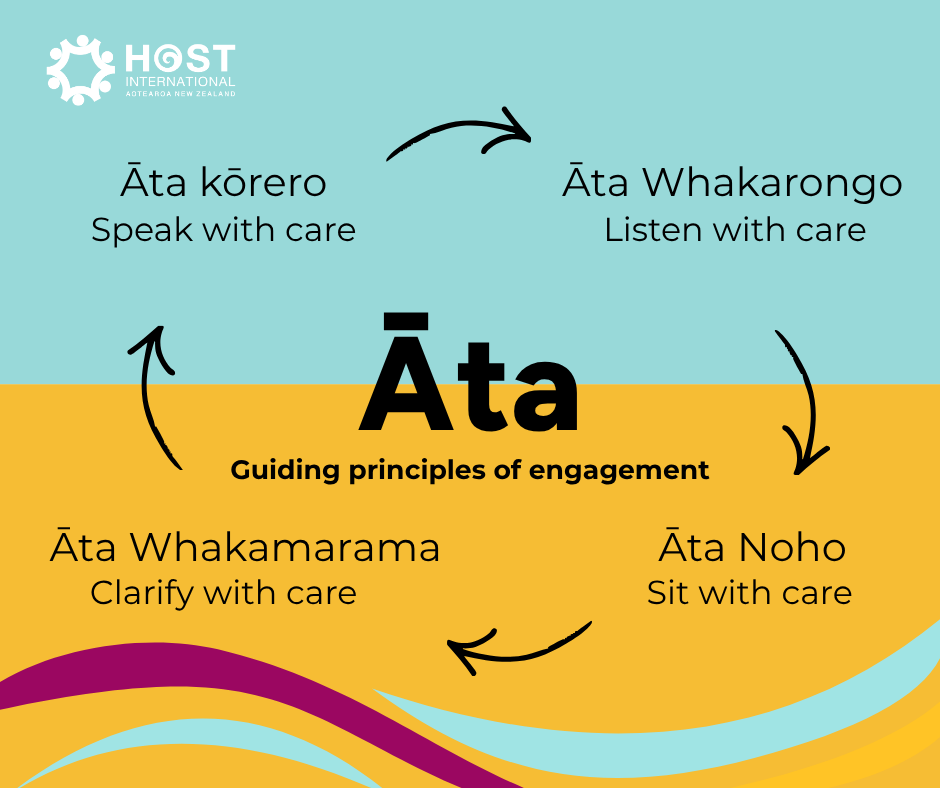
Pohatu (2013) describes Āta as both a behavioural and theoretical strategy that nurtures the development of respectful relationships. It encourages people to move carefully, think deeply, and act with deliberate intention. These takepū (guiding principles) provide ethical direction for every stage of engagement; how we enter into relationships, how we remain present and conduct ourselves within them, and how we conclude those interactions with care. While there are many takepū within the Āta framework, we focus on four that are especially relevant to our practice: āta kōrero (speak with care), āta whakarongo (listen with care), āta noho (sit with care), and āta whakamārama (clarify with care).
Hollis-English (2016) reinforces the importance of such Māori frameworks in social services, arguing that Māori concepts like Āta have long informed practice in Aotearoa, particularly through the legacy of Pūao‑te‑Āta‑tū, which called for culturally grounded, anti‑racist, and relationally respectful approaches.
Together, these authors highlight that Āta goes deeper than a cultural idea. Āta is a practical tool for strengthening social service work.
Āta Kōrero (Speak with Care)
Āta kōrero reminds practitioners that words carry weight. Speaking with care means choosing language that uplifts, clarifies, and avoids harm. In social services, where clients may be navigating trauma, uncertainty, or systemic barriers, this principle encourages:
clear, compassionate communication
avoiding rushed or dismissive explanations
ensuring that information is delivered in a mana‑enhancing way
Pohatu (2013) emphasises that careful speech builds trust and supports ethical relationships, an essential foundation for effective practice.
Āta Whakarongo (Listen with Care)
Listening is more than hearing. Āta whakarongo asks practitioners to listen deeply, attentively, and without interruption. This principle aligns with trauma‑informed practice, where clients’ stories must be received with respect and patience.
Hollis-English (2016) notes that Māori social work traditions have long emphasised listening as a relational act that acknowledges mana and fosters connection. In practice, this means:
giving clients time to express themselves
listening for meaning, not just information
recognising silence as part of communication
Deep listening helps practitioners understand not only what is said, but what is meant.
Āta Noho (Sit with Care)
Āta noho encourages practitioners to be fully present. It is about creating a calm, grounded space where people feel safe to share their experiences. In social service settings, this principle supports:
slowing down during meetings or assessments
creating environments where clients feel welcomed
being emotionally and mentally present
Pohatu (2013) describes āta noho as a way of honouring the relational space between people. For practitioners, it is a reminder that presence itself can be healing.
Āta Whakamarama (Clarify with Care)
Clarity is essential in social services, where misunderstandings can have significant consequences. Āta whakamārama encourages practitioners to seek and offer clarity with patience and respect. This includes:
checking understanding
explaining processes in accessible ways
ensuring clients feel confident asking questions
This principle aligns with Hollis-English (2016) argument that culturally grounded practice requires transparency and shared understanding.

Why Āta Shapes the Way We Work
The principles of Āta strengthen our practice in several ways:
Building trust, which is essential for working with in communities.
Upholding cultural safety in our work alongside refugee and migrant background communities, guided by Te Tiriti o Waitangi.
Enhancing communication, reducing misunderstandings and harm.
Promoting ethical, relational practice, which is central HOST values.
Aligning with trauma‑informed approaches, emphasising presence, respect, and empowerment.
The āta principles collectively strengthen our commitment to dignity, empowerment, and relational integrity. They support culturally responsive practice aligned with Te Tiriti o Waitangi and enhance HOST’s ability to work respectfully with Māori communities and with people from diverse cultural backgrounds. In a sector where time pressures, complex needs, and emotional intensity are common, Āta offers a grounding framework that brings us back to what matters most: the quality of the relationship.
Conclusion
Āta offers a powerful, culturally grounded framework for ethical and relational practice. By integrating āta kōrero, āta whakarongo, āta noho, and āta whakamārama into everyday work, HOST strengthens its capacity to support displaced communities with compassion, clarity, and cultural integrity. These principles not only enhance practice but also contribute to a more just, respectful, and humane environment.
References
Hollis-English, A. (2016). Pūao-te-Āta-tu: Informing Māori social work since 1986. Aotearoa New Zealand Social Work, 24(3-4), 42-49. https://doi.org/10.11157/anzswj-vol24iss3-4id123
Pohatu, T. (2013). Āta: Growing respectful relationships. Āta: Journal of psychotherapy Aotearoa New Zealand, 17(1), 13-26. https://doi.org/10.9791/ajpanz.2013.02


nice text bro
I’m curious about Gates of Olympus 2500 mainly because it keeps the recognisable Zeus theme but changes the feature structure. The 6×5 Pay Anywhere grid means combinations are formed across the board rather than through fixed lines. When symbols create a result, Tumble mechanics remove them and allow new ones to fall. Then there’s the Bonus Wheel, which chooses one of four Free Spins modes. That is probably the feature I’d watch most closely after the 28 September 2026 launch. I’d also avoid reading too much into individual statistics. High volatility can produce very different short-term sessions, and a 27.93% hit-frequency figure represents a long-run measurement under the provider’s methodology, not a guarantee that something will happen after a certain number…
I appreciated how the author managed to organise the information logically. The author demonstrates a good knowledge of the subject. I saved this text so I can reread it in the future when I need it. It is an article that stands out for the quality of the information presented.
The insights shared about the Āta framework are profound, particularly in how they emphasize relational integrity in social service work. The principles outlined, especially the concept of āta kōrero, highlight the importance of communication. I wonder how the practical application of these principles will evolve over time at HOST International Aotearoa, and whether they will significantly reshape professional norms in the field. Leon offers a compelling perspective on this.
The insights on the Āta framework in social service work raise important questions about the balance between cultural practices and modern methodologies. By integrating principles like āta kōrero and āta whakarongo, practitioners can foster deeper connections. However, the practical application of these ideas remains complex, especially when organizational pressures such as time constraints are involvet principles could enhance our understanding of this balance.